

At The Ivory, we suggest giving that kind of attention a full day. Start on our rooftop terrace in Koreatown, plan a visit centered on the Lucas Museum of Narrative Art, and leave the evening free to make sense of what caught your eye. The aim is a handful of observations you will want to keep.
Morning lines above Koreatown
Begin with our complimentary morning coffee and artisan bread before taking your notebook to our open-air rooftop terrace. The panoramic city views offer plenty to draw, but a small subject is usually more revealing than an attempt to capture all of Los Angeles.
Choose one overlap between buildings or a patch of sky framed by rooflines. Draw the outline first. Then look again, this time paying attention to the empty space around it. The second look is often where the interesting detail appears.
A ten-minute sketch gives the morning a gentle focus. There is no obligation to get the perspective right. If a line refuses to cooperate, add a few words beside it. “Heavy base, light top” records a design observation perfectly well.
Before closing the notebook, circle the detail that surprised you. Carry that question into the next part of the day.
Midday form and flow at the Lucas Museum
From Koreatown, the museum stop takes you to Exposition Park. This is an out-and-back city outing, not a short walking circuit, so check your route and journey time before leaving. Confirm that the Lucas Museum of Narrative Art will be open to visitors during your stay before planning the gallery portion of the day.
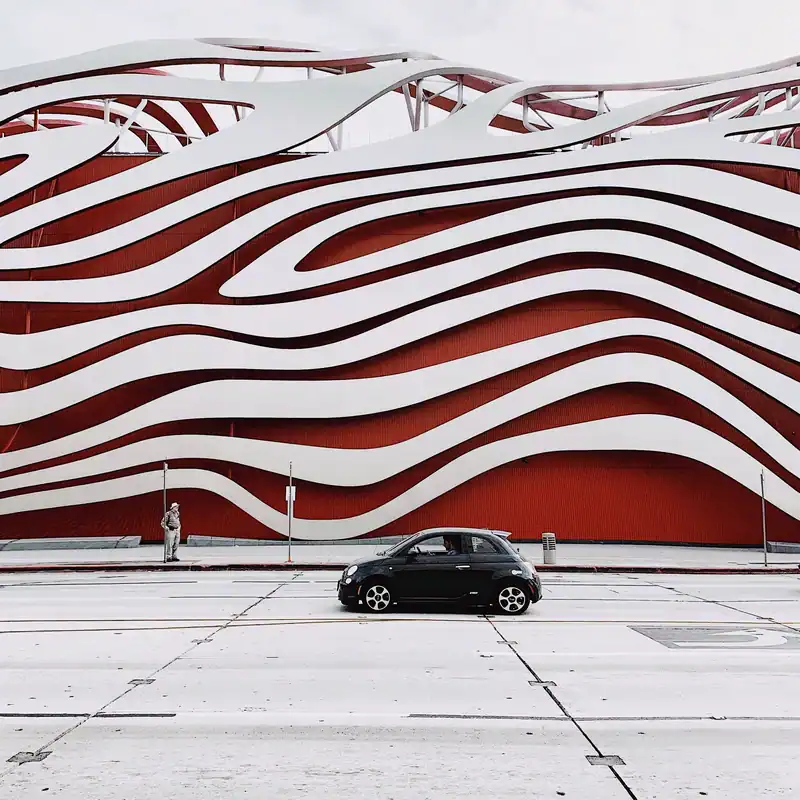
Designed by Ma Yansong of MAD Architects, the museum’s sweeping, sculptural form shifts the exercise from drawing lines to considering movement. From outside, compare its silhouette with the rooflines you studied that morning. Notice how a long curve changes your sense of the building’s scale, and where solid form gives way to open space.
The museum’s focus on visual storytelling offers another way to think about design. A composition can guide your attention before you have consciously understood its story. During a gallery visit, give one work enough time for that process to become noticeable.
Two questions can keep the looking focused:
- Which contrast or change in scale pulls your attention first?
- What does the composition leave out, and how does that help the story?
Then widen your attention to the room. A small diagram of your path can be as useful as a drawing of an artwork. Mark where you paused and what caused the pause. Was it the work itself, or the way you encountered it?
That distinction makes “flow” less abstract. It becomes the relationship between a space and the way you actually move through it, something you can recognize later in a shop or your own home.
Evening notes with warm cookies nearby
Back in your room, settle in with our warm evening cookies and open the notebook while the visit is still fresh. A few unfinished pages are enough. The point is to catch an impression while it remains specific, rather than produce a polished travel journal.
Put your morning sketch beside the museum notes. Perhaps an empty space mattered in both. Or a curve that seemed decorative from a distance turned out to guide your attention. Look for one connection worth putting into words.
“Beautiful building” records a judgment. “The curve made me follow the edge before I noticed the entrance” records how you experienced it. That is the kind of detail that can change what you see on tomorrow’s walk, even on a street you already know.
Leave a little room on the page for an unanswered question. Some observations become clearer after you have stepped away from them.
Planning a design-focused stay at The Ivory? Ask us for local recommendations to shape an unhurried day around your interests.